Qantas, the ALAEA and the future of ramp oversight

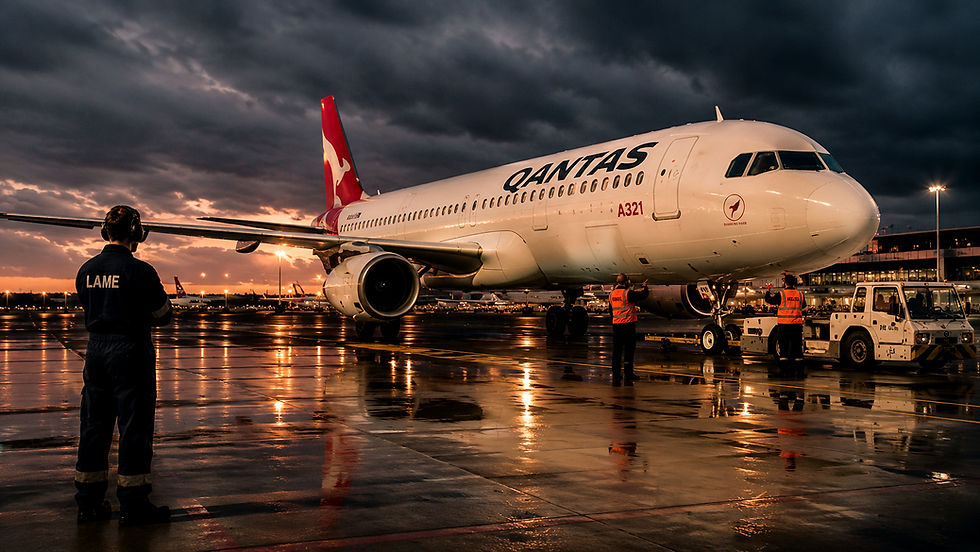
The Australian Licensed Aircraft Engineers Association (ALAEA) has taken Qantas to the Federal Court over plans to outsource receipt & dispatch and towing duties for its incoming A321XLR fleet to ground handlers like Swissport and Menzies.
But beneath the industrial dispute sits a much larger industry question: As aircraft become increasingly sophisticated and operational labour models leaner, where does regulatory compliance end and meaningful safety oversight begin?
Dispute background
On its Boeing 737 fleet, Qantas engineers currently perform receipt & dispatch activity, which encompasses inspections and being on a headset controlling the pushback, thus embedding a licensed engineering presence directly into turnaround operations. This is a long-term negotiated position within the ALAEA Enterprise Agreement (EA).
For the incoming A321XLR fleet, part of Project Winton and the broader narrowbody replacement strategy, Qantas intends to shift those functions to third-party ground handlers. Licensed Aircraft Maintenance Engineers (LAMEs) would instead focus on higher-complexity maintenance tasks aligned with the aircraft’s more advanced systems.
The ALAEA argues the change breaches enterprise agreements, impacts up to 70% of line maintenance LAME duties, and more critically was introduced without adequate consultation. The union also points to a pattern of previous outsourcing disputes that resulted in significant legal consequences for the airline. The court will ultimately determine whether the process holds up, but the operational question sits well beyond the courtroom.
Qantas’ position
Qantas is taking delivery of up to 48 A321XLRs, with entry into service expected from late 2025 on high-frequency domestic routes before expanding into Southeast Asia.
Its position is straightforward:
No LAME roles are being eliminated
Regulatory oversight remains unchanged under CASA
The model aligns with how most global carriers manage narrowbody operations
There is also precedent. In 2012, Qantas introduced “maintenance on demand” across parts of its 737 and A330 fleets, controversial at the time, but ultimately accepted by the regulator.
From Qantas’ perspective, this is not considered a step change, it’s simply a continuation of an existing operational philosophy.
What the industry actually does
In today's world, Engineer-led receipt and dispatch is not the global norm.
Across Australia, Europe, Asia, and North America, turnaround functions are typically handled by ground operations teams, including third-party providers like Swissport and Menzies, both already embedded across Qantas’ network.
Virgin Australia operates under a similar model, with LAMEs focused primarily on maintenance execution rather than routine ramp activity. Modern aircraft technology further reinforces that shift.
The A321XLR, like other next-generation narrowbodies, produces continuous health monitoring data accessible in real time. Many traditional “on-wing” checks are now supplemented by system-driven diagnostics.
But there is a catch.
Industry standard is not always the same as best practice. It is often the most efficient balance between cost, risk, and operational complexity, not necessarily the most conservative or resilient model.
The safety question
The ALAEA’s concerns are not irrational.
Ground handlers are not LAMEs, nor do they carry the same licensing, training depth, or accountability under the regulatory framework. The argument that an embedded engineering presence can identify issues others might miss is valid in principle.
What engineers bring to the ramp is not just procedural compliance, it’s pattern recognition and experience. The ability to spot something subtle, ambiguous, or just “not quite right” before it becomes a defined defect.
That value is real, but it is also difficult to quantify.
And that’s where the argument becomes uncomfortable. There is no clear evidence that removing engineer-led dispatch introduces systemic safety degradation. There is, however, also no robust evidence proving it doesn’t. The industry is currently operating in that gap.
Regulators like CASA assess systems, controls, and outcomes, not the preservation of legacy practices. And to date, similar models have been approved without observable shifts in safety performance. But absence of evidence is not evidence of absence; it simply reflects the limits of what is currently being measured.
Is the extra oversight worth It?
This is not a simple choice between safety and cost.
It is a question of how safety oversight is structured in a modern airline operating environment, and how operational efficiency is balanced against experienced human judgement on the ramp.
Qantas is pursuing efficiency, productivity gains, and workforce alignment on a new fleet using a model that is both globally common and regulator-approved. From an operational perspective, that makes the direction defensible.
But ALAEA’s position is also more nuanced than simply arguing the sky will fall without engineers performing dispatch. A significant part of the dispute appears to centre on whether Qantas has met its consultation obligations under the Enterprise Agreement before implementing the change. That is an important point.
The legal argument may ultimately prove more important than the technical one. Because even if the operational model itself is considered acceptable by regulators and common across the industry, the process used to introduce it must comply with agreed industrial frameworks.
The broader safety debate, however, remains harder to resolve conclusively. To shift industry opinion beyond the courtroom, ALAEA would still need to demonstrate that engineer-led receipt and dispatch provide a measurable safety benefit that cannot reasonably be replicated through aircraft systems, training, maintenance control oversight, and layered operational procedures.
That alone is a difficult case to prove definitively, particularly on a modern aircraft like the A321XLR.
The real trade-off
This debate is now unfolding across two separate fronts: operational philosophy and industrial due process.
The court may ultimately focus on whether Qantas met its consultation obligations under the Enterprise Agreement before implementing the change. That is a legitimate and important legal question in its own right.
But beyond the legal dispute sits the broader industry question.
As airlines introduce increasingly sophisticated aircraft and more data-driven predictive maintenance systems, the role of experienced human oversight on the ramp is inevitably being re-evaluated. The challenge is that the value of experienced engineering judgement is often difficult to measure until after it is absent.
Qantas is far from alone in moving toward leaner, globally standardised operating models.
The A321XLR outsourcing approach reflects where much of the industry has already gone.
Whether that represents sensible modernisation or the gradual erosion of an additional safety buffer will remain heavily debated long after the court case concludes.
And that is the conversation the industry should really be paying attention to.
Craig Reid Director, Jotore Aviation Consulting
This article reflects independent analysis and does not represent the position of any client.
Jotore Aviation is available for direct advisory engagements, contact Craig Reid directly at support@jotoreaviation.au.

Well written Craig, a complex position for both parties, some embedded in historical work practices and the constant drive for continuous improvement. Albeit with the balance of safety and cost in mind. KB
Nice piece Craig
As you have stated the practice of using ramp handling companies is wide spread across aviation globally
Proper training coupled with audit oversight will provide staff capable to perform the turn around duties.
The ALAEA needs to look forward in aviation and not hang onto work practices of years ago
Nice summary Craig, for info theQantas 787 fleet has had GSP push backs since its introduction in 2017