Five Incidents, Sixteen Days: What Happens When Recruitment Runs a Decade Behind Retirement

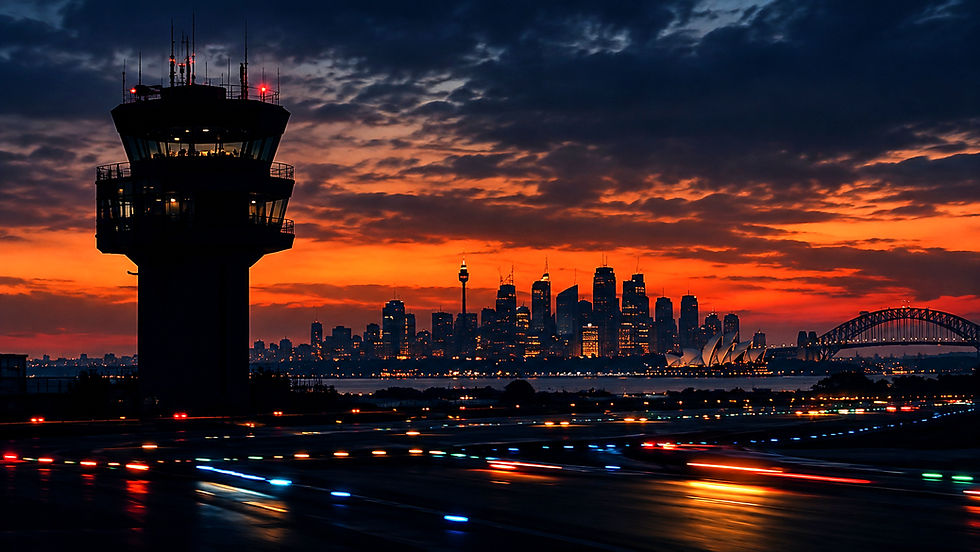
Between 27 July and 25 August 2026, six separate air traffic control occurrences at Sydney Airport were referred to the Australian Transport Safety Bureau. Five aircraft came within metres of each other in ground movements that should never have been in the same space at the same time. One cabin crew member was injured. In at least two cases, the ATSB's own chief commissioner has said it was the actions of the pilots on board, not the system around them, that prevented something far worse.
This is not a story about Sydney Airport, the airport owns the tarmac. Airservices Australia, the federal government-owned corporation, owns the tower, the controllers, and the rosters. That distinction is important, because it tells you exactly where to look for the failure, and exactly where the fix has to land.
The sequence
27 July – A Qantas 737 was cleared to cross runway 34L while a QantasLink Dash 8 was still in its landing roll on the same runway. Controllers caught the conflict and the 737 stopped short.
9 August – A Jetstar A320 taxiing for departure came into close proximity with a Qatar Airways 777 under tow on a crossing taxiway. Both aircraft stopped abruptly, and a cabin crew member was injured. This was the only occurrence of the six, classified as a near collision.
9 August, same morning – A Virgin Australia 737 had already applied take-off thrust on runway 34L when a Qantas 737 began crossing the same runway ahead of it, reportedly on its own ATC clearance. The Virgin crew aborted. This incident took four days to reach the ATSB, a delay the Bureau's chief commissioner publicly questioned.
17 August – A taxiing conflict between two Boeing 737s.
18 August – Two aircraft, an A321 and a 737, taxied toward each other on intersecting clearances. One crew spotted the other and stopped in time.
25 August – Incomplete traffic information was passed to a Jetstar A320, resulting in a Dash 8 taxiing behind it without the full picture.
Five incidents in the ATC/ground-movement category inside sixteen days, bookended by a sixth three weeks earlier that set the pattern. That is not statistical noise at a single airport.
That is a system under sustained strain, producing the same failure mode on repeat.
What Airservices has said
Airservices Australia's public position has been consistent: safety has not been compromised. CEO Rob Sharp has pointed to a 44 per cent reduction in delays at the airport over the past two years, new tower controllers endorsed in the past eighteen months, and a new simulator to lift training throughput. Initial internal reviews, Airservices says, have not identified a systemic issue.
That statement deserves to be taken at face value and tested against the record at the same time. Both can be true: no single procedural breach, and a workforce stretched thin enough that the margin for error keeps narrowing.
What everyone else has said
Civil Air Australia, the union representing air traffic controllers, describes resourcing as a long-running issue, with controllers working ten shifts on and one day off, on repeat, to keep the tower staffed. A retired airline pilot and safety investigator has warned publicly of potentially catastrophic consequences if the underlying issues aren't resolved. A UNSW researcher tracking runway incursions has identified a rising national trend over more than two decades, which means Sydney is the sharpest current symptom of a problem that isn't confined to one tower.
Most tellingly: workers inside Airservices had already raised the alarm before this sequence began. Confidential safety reports and at least one whistleblower account describe grave concerns about staffing being flagged internally ahead of this run of incidents, not after it.
Where the resourcing actually broke
The shortage did not appear in July 2026. Transport Minister Catherine King has publicly attributed it to a pandemic-era government policy that encouraged air traffic controllers over 56 to retire early with lump-sum payments, a decision she has called short-sighted. That policy removed a large cohort of the most experienced controllers from the system in a short window.
The refill has been slow for a structural reason: Airservices' own figures put controller training at roughly a year from entrance exam to console. Recruitment only ramped up meaningfully well after the experienced cohort had already left. As of the current reporting, six controllers are still in training in Sydney Tower, with another fifteen not expected to start until before the end of 2027. That is not a workforce that was fully rebuilt when this year's incidents happened. It is a workforce still mid-repair, running on overtime and roster gaps while the pipeline slowly refills.
The SMS question
This is the part that should concern anyone who has built or relied on a safety management system. An SMS exists precisely so an organisation doesn't need a near miss to know something is wrong. Fatigue rosters, overtime rates, sick leave patterns, and internal safety reports are leading indicators. They are supposed to surface a developing risk long before two aircraft are close enough that a pilot's reaction time is the only thing standing between an incident and an accident.
By the industry's own account, those indicators existed. Confidential reports were already being filed. Rostering strain was already visible and already being discussed publicly by the union representing the people working the boards. The retirement-to-recruitment gap was a matter of public record, not a hidden risk.
None of that makes the five incidents in August inevitable, but it does make them foreseeable in the sense that matters for an SMS: the data to predict elevated risk was already sitting in the organisation before the risk materialised on a runway.
Acceptable, surprising, dangerous
Is it acceptable? No. Five ATC-attributable ground occurrences in sixteen days at the country's busiest airport sits well outside normal variation, and the people closest to the problem, the union and a retired safety investigator among them, are on the record saying so.
Is it surprising? Less than it should be. The warnings predate the incidents, and this is closer to a predicted outcome than a shock, which is a harder thing to sit with than "bad luck," because it means the opportunity to act on the data existed and wasn't taken quickly enough.
Is it dangerous? By the regulator's own account, yes. The ATSB's chief commissioner has said plainly that pilot action, not the system, is the reason at least two of these did not end more seriously.
The real question for the industry
The honest framing isn't "how did this happen in today's aviation environment." It's "why did an organisation with the safety reporting culture to know this was coming still take this long to close the gap." A workforce hollowed out by a short-sighted retirement policy, refilled on a training pipeline that takes a year per controller, running on overtime while the numbers slowly recover, is not a mystery. It's a resourcing decision with a long, predictable tail, and the tail is what showed up on Sydney's runways in August.
The fix isn't a statement that safety wasn't compromised. It's closing the gap between when the data says a risk is building and when the organisation acts on it. On this evidence, that gap was measured in years, not days.
Jotore Aviation Consulting provides maintenance strategy, regulatory compliance, and CAMO/AMO advisory services to Australian aviation operators. For more aviation industry analysis, visit and sign up at www.jotoreaviation.au.


Comments