The Eiffel Tower Was the World's First Aerodynamics Lab

Ask most people what the Eiffel Tower is for, and you'll get some version of the same answer: it was built to be looked at. A monument, or a centrepiece for the 1889 World's Fair, and nothing more.
They're wrong, and the man who built it would have told them so himself.
Gustave Eiffel wasn't a romantic, he was a structural engineer with a lifelong, borderline obsessive respect for one force above all others: wind. He'd spent his career designing bridges and viaducts across France, and every one of those designs lived or died on how well he understood what wind did to a structure under load. As he put it himself, later in life: "The wind has always been a concern for me. It was an enemy."
So, when his tower was finished and the fairground exhibits eventually came down around it, Eiffel didn't retire into being a monument's namesake. He turned the tallest structure on Earth into a piece of laboratory equipment, and in doing so, helped lay the actual technical foundations of aerodynamics as a science, the same science that keeps every aircraft flying today.
The drop-test machine
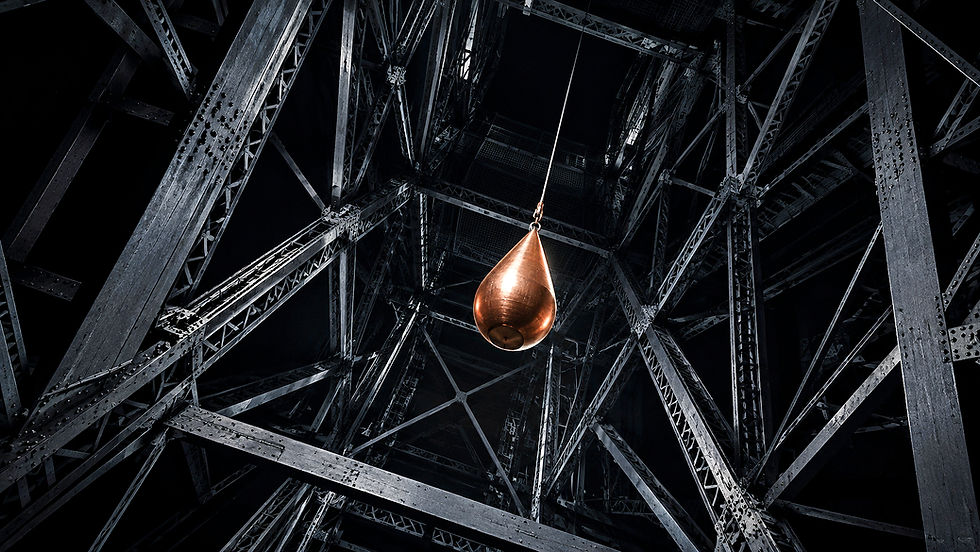
In 1903, at 71 years old, Eiffel built something deceptively simple: a device that dropped precisely shaped test bodies along a vertical cable strung from the tower's second level, roughly 115 metres up. As each shape fell, an onboard mechanism measured and recorded its drag and fall velocity onto a chart, in real time.
Over the next three years, he tested around 40 different shapes this way. It was, for its time, the most advanced apparatus of its kind anywhere in the world, and it wasn't a hobby. In 1908, the French Academy of Sciences formally recognised the research, and Eiffel used the results to establish some of the fundamental laws of air resistance.
That's worth recognizing, that a man best known for riveted iron lattice work spent his seventies producing some of the most accurate aerodynamic data that existed anywhere on the planet, by dropping shaped objects off his own tower and timing how fast the air fought back.
Why he built a wind tunnel next
Drop tests had an obvious limitation: gravity doesn't wait around. Each test lasted only a few seconds, which wasn't enough time to properly study more complex shapes or behaviours.
So, in 1909, Eiffel built his first wind tunnel at the foot of the tower, powered, fittingly, by the same generator that ran the tower's own lifts and lights. But this wasn't just about convenience. Eiffel had a genuinely important scientific question to answer first: does a stationary object sitting in moving air experience the same drag as that same object moving through still air?
It sounds obvious now, but it wasn't proven then. Eiffel ran the same 40-odd shapes through his new wind tunnel that he'd already drop-tested off the tower, compared the results, and confirmed they matched. That single finding, now taken completely for granted, is the entire working principle behind every wind tunnel built since, including the ones Boeing, Airbus, and every major manufacturer still use to validate aircraft designs before they ever leave the ground.
Auteuil: the laboratory that's still running today
By 1911, Paris had started redeveloping the land around the Champ de Mars, and Eiffel needed a permanent home for his research. He built a considerably more sophisticated laboratory at 67 Rue Boileau, in the Auteuil district, funded entirely at his own expense.
This is the part of the story that genuinely surprised me. The Auteuil wind tunnel wasn't a one-off curiosity that got mothballed once Eiffel died. Real aircraft pioneers used it to test wing profiles during the earliest years of powered flight, the Wright brothers, Voisin, Farman, and Blériot among them, followed later by complete aircraft models from Esnault-Pelterie, Nieuport, and Levasseur. Eiffel also studied propeller design there, at a time when nobody had yet worked out the aerodynamics that make a propeller efficient rather than just spinning metal.
In 1920, Eiffel, who was then 88 years old, donated the facility to the French government. It's operated continuously ever since. It's now recognised as the oldest surviving aeronautical laboratory in the world with its original wind tunnel still intact, and it carries French National Monument status. It's still used today to test aircraft, buildings, and Formula 1 cars.
A lab built by a 19th century bridge engineer, testing 1900s biplane wings by candlelight-era standards, is still producing usable aerodynamic data for Formula 1 teams in the twenty-first century.
What this actually means for aviation today
Eiffel wasn't working in complete isolation, a handful of contemporaries, including Nikolai Zhukovsky in Russia and Thomas Stanton in Britain, were building their own wind tunnels in roughly the same period. Aerodynamics as a formal discipline was being born in several places at once, not invented by one man alone.
But Eiffel brought something the field badly needed at the time: an engineer's discipline applied to a science that had, until then, produced very little reliable, repeatable data. He didn't just build equipment. He established a laboratory model, rigorous method, careful instrumentation, validated results, that shaped how aerodynamic research was conducted for the century that followed. When you trace the lineage of the modern wind tunnel, the validated relative-motion principle, and the very idea that aircraft design should be tested against measured data rather than guesswork, it runs directly back through a lab a bridge builder financed out of his own pocket, next to a tower everyone assumed was just for looking at.
Every aircraft flying today, every wing profile shaped by CFD modelling and wind tunnel validation, exists downstream of an old man dropping shaped metal off the second level of his own tower, because he needed to know whether the wind, he'd spent his whole career fearing actually behaved the way he thought it did.
He was right, and 120 years later, we're all still flying on the answer.
Jotore Aviation Consulting provides maintenance strategy, regulatory compliance, and CAMO/AMO advisory services to Australian aviation operators. For more aviation history and industry analysis, visit www.jotoreaviation.au


Comments