The Bonza Debate Misses the Real Problem: Resilience

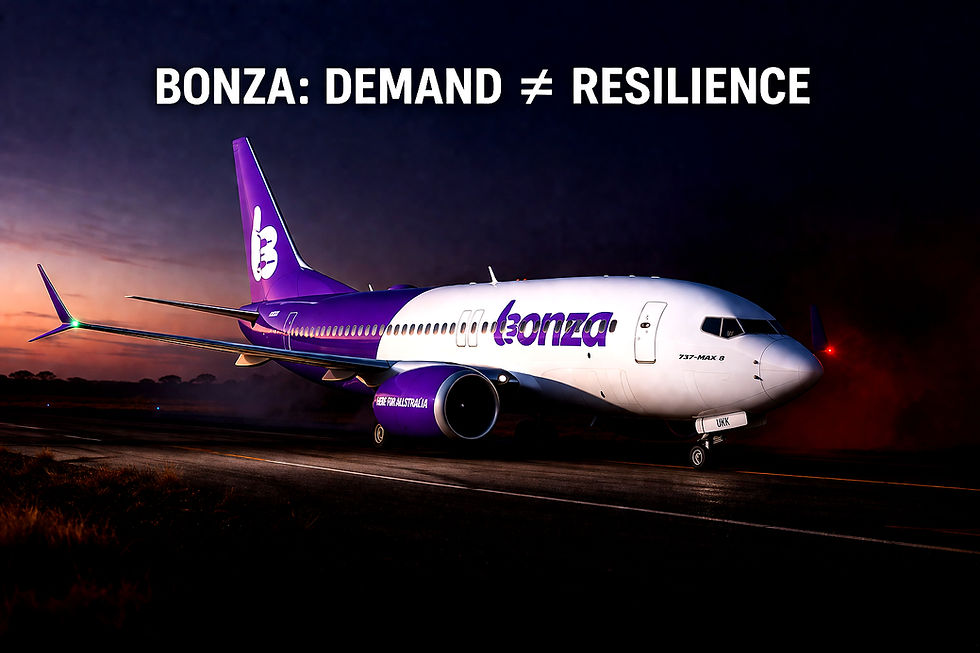
Tim Jordan is not wrong to argue that Bonza found an audience. Australia does have demand for lower fares, more choice, and a better regional-to-metropolitan value proposition. But that is only one part of the story.
The bigger question is not whether there was some demand for Bonza, or whether the duopoly was comfortable, but whether Bonza had the operational resilience to survive long enough to turn demand into a durable airline. That is where the current debate misses the point.
In a recent podcast by Australian Aviation's Jake Nelson, Jordan's discussion has leaned heavily toward the familiar framing: Bonza was constrained by the 777 Partners collapse, by Australian market structure, and by the broader reality of a highly concentrated domestic airline sector. Those factors mattered, and they always do. But they are not enough on their own to explain why Bonza failed so quickly, or why the outcome felt so inevitable once the cracks started to show. The inconvenient truth is that airlines do not fail only because capital disappears. They fail because the operating model underneath them is too fragile to absorb pressure.
Bonza, in my view, was one of those cases.
Demand Is Not the Same as Durability
It is easy to say there is room for another domestic airline in Australia. In a spreadsheet sense, that is absolutely plausible. In a market-concentration debate, it can even sound persuasive. But demand is not the same thing as durability.
An airline can attract curiosity, trial bookings, and even public goodwill without possessing the deeper structural capacity to survive disruption, build loyalty, and scale safely. That distinction matters. It matters enormously.
Bonza’s early appeal rested on a simple proposition: underserved routes, lower fares, and a sense that the incumbents had become too comfortable. That proposition had merit. But merit is not equal operational resilience. Resilience is what happens when the airline is hit by supplier stress, roster pressure, fleet complexity, maintenance dependency, operational delay, and the inevitable friction that comes with growth.
That is where Bonza’s model looks far less convincing.
The Small Details Were Not Small
What is often omitted in the public narrative is the 'operational plumbing'. These are not glamorous CEO talking points, but they are the difference between an airline that scales and an airline that begins to wobble.
There are several areas that, in hindsight, deserve much more attention.
Examples of Operational Limitations:
Engineering availability
Licensed Aircraft Maintenance Engineer (LAME) availability is not an afterthought and is one challenge being faced by the duopoly operators currently. It is one of the core enablers of reliability. If your maintenance supplier is small, growing, and still trying to mature at the same time as the airline, you have built fragility into the system from day one.
That does not automatically condemn the airline, but it does mean the airline is walking a narrow path. If the roster breaks, if the line maintenance support is stretched, if a technical issue emerges at the wrong airport, or if the aircraft’s maintenance needs grow faster than the support structure, the whole operation becomes vulnerable. That kind of fragility is not usually visible in a public-facing launch campaign. It only becomes obvious when the system is under load, and Bonza was.
Infrastructure constraints
Airline success is not just about flying aircraft. It is also about having somewhere to keep them, service them, and turn them efficiently. Storage of GSE, access to suitable infrastructure, and the practical realities of airport support are not side issues. They are operational foundations.
A small or emerging carrier often discovers that infrastructure is not neutral. It is either available, scalable, and efficient, or it is a hidden constraint that slowly weakens the operation. If the airline is trying to build a new model while also negotiating limited infrastructure access, the complexity compounds very quickly. In a mature market, the biggest carriers often enjoy structural advantages that newer entrants underestimate. Bonza, appears to have run into that reality far earlier than its supporters wanted to admit.
Rosters and resilience
Rosters are another area where good intentions meet hard reality. A small airline with thin depth in its workforce can look lean on paper and fragile in practice. Resilience in rosters means more than having enough names on a schedule. It means having enough flexibility to absorb illness, disruption, fatigue management, sudden operational changes, and the inevitable reality that aviation does not run according to plan.
If that flexibility is missing, the system starts to strain. And once it strains, everything gets harder: punctuality, morale, customer confidence, and management credibility. An airline can survive a few operational shocks. It cannot survive a structure that is permanently just one disruption away from becoming unstable.
Larger-gauge aircraft on regional routes
The decision to operate larger-gauge aircraft on regional routes also matters. On paper, a larger aircraft may seem like a way to improve seat economics. In practice, it can create a mismatch between capacity, demand, and operational flexibility, even with a load factor of 70%.
Regional aviation is often less forgiving than people assume. Demand can be seasonal, route economics are delicate, and airport infrastructure can be limited. Put a larger aircraft into that environment and the airline must be exceptionally disciplined in planning, utilisation, and cost control. If the demand is not as robust as expected, or if the schedule cannot flex quickly enough, the aircraft becomes a burden rather than an advantage. In that sense, fleet choice is not just a commercial decision. It is an operational commitment that can either support the airline or trap it.
Where the Bonza Narrative Becomes Convenient
This is where I think the public explanation becomes too simplistic. It is easy to focus on 777 Partners, and yes, the financial backer mattered. It is easy to point to the duopoly, and yes, competition in Australia has never been easy. It is easy to argue emotionally, that more airlines should be possible in a market this size. That argument has public support and potential political appeal.
But it can also become a convenient shield against harder questions.
Was the operation genuinely scalable?
Was the maintenance model strong enough?
Was the infrastructure in place to support the growth?
Were the rosters resilient enough for a new fleet of six aircraft?
Was the fleet and network design matched to the realities of the market?
Was the organisation growing faster than its operating backbone?
Those should not be theoretical questions; they are the questions that determine whether an airline can absorb the first serious shock.
Why The Duopoly Argument Is Only Half Right
I do not dismiss the duopoly argument. In fact, I think it is partly correct. The Australian market has long rewarded incumbency, scale, and network control. That makes it harder for new entrants to survive. It also means consumers can be left with fewer choices than they deserve, that's a fact. But that does not absolve the entrant from having to build a model that can endure.
A hard market explains operational pressure. It does not explain all the failure.
If the structure is hostile, the airline must be more resilient, not less. If the incumbents can match fares, the newcomer must be more disciplined. If the backer is fragile, the operation must be stronger. If the fleet is small, the maintenance system must be exceptionally tight. If the route network is ambitious, the infrastructure and workforce support must be capable of carrying it.
Bonza by any of those metrics did not appear to have enough of that resilience.
The Australian Lesson Nobody Wants To Say Aloud
Australia may be a large domestic market in population terms, but aviation is not governed by population alone. Geography, distance, airport constraints, labour depth, infrastructure quality, supplier concentration, and market behaviour all shape whether a new airline can actually survive.
That is clearly why so many attempts have failed here.
Compass Mark I & II. Tiger. Bonza. Several regional operators.
Different eras, different models, similar ending.
The pattern is not random. Australia can support more airlines, but it cannot support weak airlines for long. The market is large, but it is unforgiving. It rewards execution, discipline, and resilience more than aspiration. That is the real problem.
Where the Podcast Narrative Falls Short
Recent commentary from Tim Jordan attempts to reframe Bonza’s collapse as a story of external forces and missed opportunities. That version and some other broad claims, I believe, deserve scrutiny.
1. “There has been no Australian investment in Mainstream aviation this century"
That is true, but it conveniently overlooks what happened late last century, in the 1990s. Compass Mark I was exactly the kind of Australian‑backed airline he describes: a venture that struggled to attract institutional capital, ended up with a public retail float funded by ordinary Australians, and ultimately left many of those investors out of pocket and burnt by aviation. Bryan Grey initially tried to raise institutional money, failed (sound familiar), and was forced to fall back on a public offer. The company raised $65 million from the public, with a small additional block of shares to the founder, plus a “Compass Owners Club” that sold shareholders discounted travel along with their equity. Compass also received Queensland government support and built its base at Coolangatta. So, the story of an Australian airline backed by local capital and public investors is not new. It is just one that people have long memories, and good reasons, to remember.
2. “Bonza was on the up” but where are the operational metrics? Revenue claims in isolation are meaningless in aviation. What matters is operational integrity, on-time performance (OTP), technical dispatch reliability (TDR), and cancellations. Bonza’s network was routinely disrupted, with aircraft utilisation volatility and crewing constraints well understood across the industry. An airline cannot claim momentum if it cannot deliver a reliable product. Demand without delivery is not growth, it’s leakage. *Bonza's On-Time Performance (OTP) was volatile, peaking as Australia's most punctual airline in early 2024 (78.4% arrivals, Jan) before collapsing to the worst in Dec 2023 (52.6% arrivals) due to Gold Coast base approval delays.
3. $1M/month overhead. Is not a surprise, but not the point either. An airline’s fixed cost base is never the issue in isolation. The question is whether revenue and operational execution justify that cost. If your cost base is predictable but your operation is not, the problem is not overhead, it’s execution discipline.
4. Blaming 777 Partners is a governance failure, not bad luck. External investors failing to deliver is not a novel nor isolated aviation story in Australia (see Compass). That risk sits squarely within executive and board accountability. Due diligence is not optional when your entire capital structure depends on a single funding source. Concentration risk of that scale should have been mitigated early, or the strategy adjusted accordingly.
5. “Others don’t start new routes”. Qantas, Virgin Australia, and Jetstar Airways have launched and tested multiple new routes in the past two years, domestically and internationally. The difference is not willingness; it is route data discipline and network patience. Routes are added, adjusted, or exited based on performance. That is standard airline practice, regardless of belief.
6. “The regional market is proven”. Well, only if you can serve it reliably. Demand signals alone do not create a viable market. Aviation markets exist where demand, yield, and operational consistency intersect. If you cannot service a route reliably, it is not yet a market, it is an experiment. There is a reason competitors did not rush to backfill Bonza routes: they likely failed the test either commercially, operationally, or both.
7. The “duopoly” argument is somewhat overstated. Australia’s market structure is stable, but not immovable. Entrants could succeed, if they are well-capitalised, operationally robust, and strategically disciplined. Blaming the duopoly, risks ignoring the more immediate internal failures of Bonza.
8. Strategic drift: the abandoned 70-seat turboprop model. Bonza’s original proposition of smaller aircraft, lower risk, thinner routes, had strategic and operational logic. Moving to a 737-only model increased capital intensity, operational complexity, and break-even thresholds. That shift required flawless execution. It did not get it.
9. The “mystery investor” narrative. Claims of alternative funding without transparency raise more questions than answers. In distressed aviation businesses, “near investors” are common, closed funding is what matters. If capital was not secured, it ultimately was not real.
The Final Thought
Tim Jordan may be right that Bonza was not simply a vanity project and not simply a theft of traffic from the majors. But he is in my mind, too generous, if he is implying the collapse was mostly external. The internal operating fragility mattered. Probably more than the public narrative has allowed.
Bonza was not defeated by one factor. It was exposed by several at once. Financial dependence. Operational stretch. Infrastructure pressure. Maintenance fragility. Roster risk. Fleet and route complexity. All of it came together in a market that does not forgive weakness.
That is why the debate should not be centred around whether Australia needs more airlines.
It should be about whether the next one is built to last.
Stay Safe,
Craig.
*Jotore Aviation Blog "Bonza's Silent Mayday": https://www.jotoreaviation.au/post/bonza-s-silent-mayday
*Australian Aviation Podcast: Bonza's Tim Jordan breaks his Silence (Jake Nelson)


Comments